
Blog
Research Peptide Storage Temperature Guide

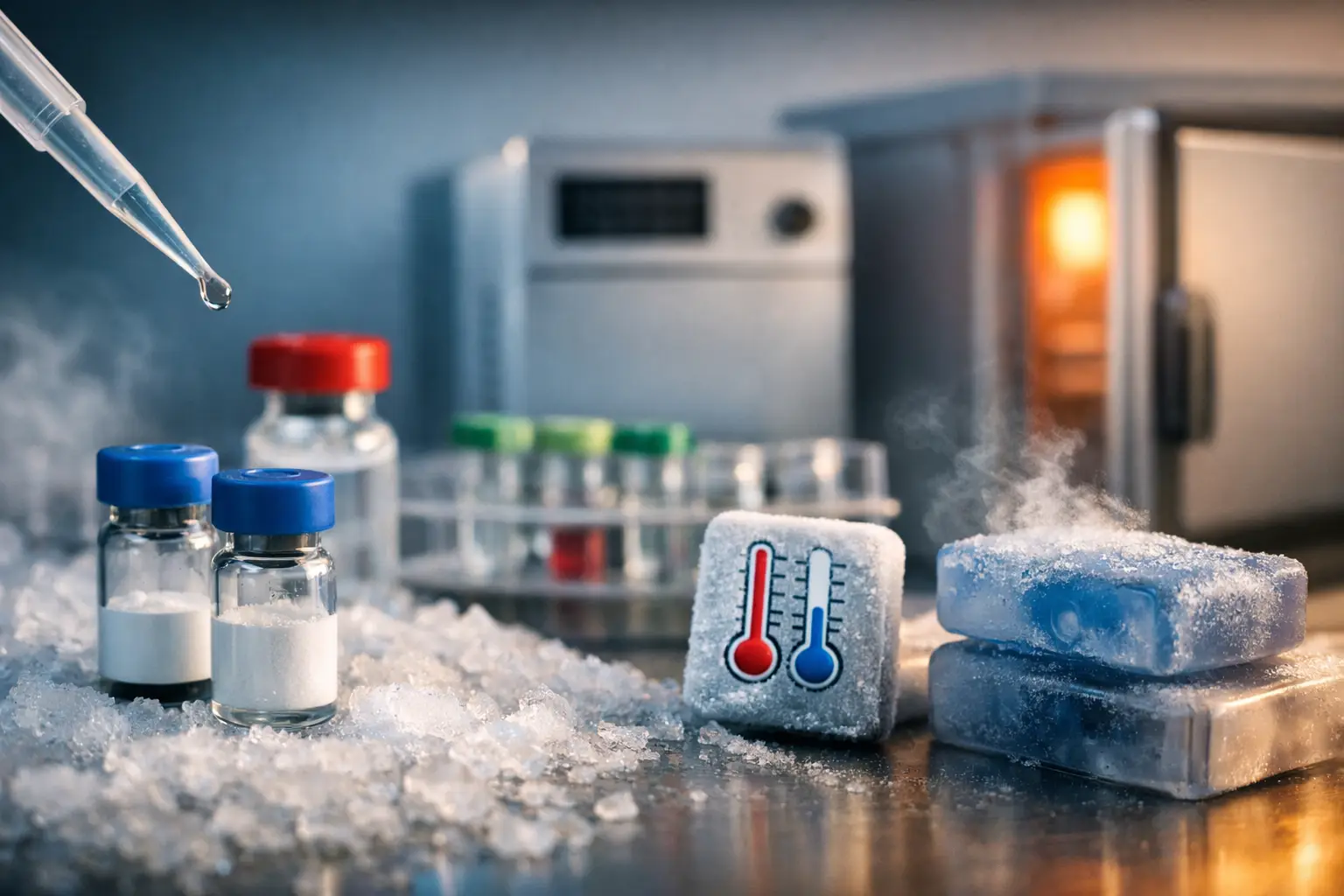
A vial can arrive in suitable condition and still become a variable in the experiment if handling begins without a defined storage plan. Research peptide storage temperature is not a generic freezer setting. It depends on whether the material is lyophilized or reconstituted, the compound’s documented requirements, container integrity, planned use interval, and the temperature control available at the research site.
For Research Use Only. Storage guidance supports material control and experimental repeatability. It does not replace the product label, certificate of analysis, supplier documentation, or an established laboratory protocol.
Why Research Peptide Storage Temperature Matters
Peptides are sequences of amino acids with physical and chemical properties that vary by compound. Temperature affects molecular movement and can influence degradation pathways over time. The risk is rarely temperature alone. Moisture exposure, light, repeated warming, contamination after reconstitution, and incomplete records can compound the problem.
A controlled storage process protects more than the vial. It protects the interpretability of the work. When a result differs from expectation, a documented chain of storage conditions helps distinguish a material-handling question from an experimental variable.
The practical goal is consistency. Store comparable materials under comparable conditions, limit unnecessary handling, and record deviations rather than assuming they are irrelevant.
Storage Temperature Starts With Material State
The most useful first distinction is between unopened lyophilized material and a reconstituted solution. These states do not have the same stability profile or handling demands.
Lyophilized research peptides
Lyophilized, or freeze-dried, peptide material is generally more stable than the same peptide in solution when kept dry and protected from unsuitable conditions. For longer storage, supplier guidance may specify frozen storage, often at temperatures such as -20°C or below. Some materials or longer-term protocols may call for lower-temperature storage, including -80°C.
A refrigerator range of 2-8°C may be appropriate for certain short-term needs, but it should not be treated as a universal default for every unopened vial. The product-specific instruction controls. If documentation identifies a frozen condition, a refrigerator is not an equivalent substitute simply because the vial remains cold.
Keep lyophilized vials sealed until preparation is required. Opening a cold vial before it has equilibrated appropriately can introduce condensation, and condensation introduces moisture. Moisture is a meaningful risk because it changes the controlled dry state of the material.
Reconstituted peptide solutions
Once reconstituted, the storage decision becomes more restrictive. A solution’s stability depends on the peptide, solvent or diluent, final concentration, container, handling technique, and storage interval. Refrigerated storage at 2-8°C is common in research workflows for short-term use, but common is not the same as universally validated.
Some research protocols support freezing reconstituted material in small aliquots. Others avoid it because repeated freeze-thaw exposure, adsorption to surfaces, or concentration changes can complicate the work. Follow compound-specific documentation and the laboratory method used for that study.
Do not assign a blanket beyond-use period to all reconstituted peptides. If a supplier does not provide a stability window for the selected storage condition, the conservative operational choice is to prepare only the quantity needed for the planned research interval and document the uncertainty.
Use the Supplier’s Requirements as the Primary Control
Generic advice is useful only until it conflicts with the documentation provided for a specific material. Storage instructions on the vial, product page, certificate of analysis, or technical documentation should be reviewed before the shipment is placed into inventory.
This review should answer a few operational questions: What temperature range is specified? Is the instruction for lyophilized material, reconstituted material, or both? Is protection from light required? Is a short-term refrigeration window identified? Are there any stated limits on freeze-thaw cycles?
If those answers are missing, do not fill the gap with assumptions drawn from a different peptide. Similar names, vial sizes, or research categories do not establish identical stability characteristics. A clear internal note stating that no compound-specific stability window was supplied is more defensible than an undocumented estimate.
Build a Controlled Storage Workflow
Temperature control is only reliable when the workflow around it is controlled. A laboratory freezer that is repeatedly opened, overloaded, or used without monitoring may create more variation than its setpoint suggests.
Use a designated refrigerator or freezer where possible, with a thermometer or data logger that verifies actual conditions rather than relying solely on the display. Record minimum and maximum temperatures at an interval appropriate to the research setting. For valuable or time-sensitive material, establish an alarm or response plan for excursions.
Keep vials organized in clearly labeled secondary containers. Labels should identify the compound, lot number, received date, storage condition, and, after preparation, reconstitution date and concentration. A vial that cannot be positively identified should not enter an active workflow.
Light protection also deserves attention. If product documentation calls for protection from light, retain the vial in its original protective packaging or use an appropriate opaque secondary container. Do not place labels over critical product information that may be needed later for verification.
Limit Freeze-Thaw Exposure and Unnecessary Access
Repeated movement between frozen and warmer conditions can introduce avoidable variability. This is particularly relevant for reconstituted solutions, where each thawing event adds handling time and potential exposure to contamination or light.
Aliquoting can reduce repeated access when it is compatible with the validated protocol. Rather than thawing one larger container for every session, researchers may prepare appropriately sized portions under controlled conditions. The trade-off is that aliquoting adds a preparation step, creates more containers to track, and requires suitable sterile technique and labeling discipline.
For lyophilized vials, avoid opening the container merely to inspect it. Each opening is an opportunity for moisture and environmental exposure. If visual inspection is needed, perform it according to the laboratory procedure and document any concern such as damaged seals, visible moisture, or labeling discrepancies.
What to Do After a Temperature Excursion
A temperature excursion does not automatically prove that a material is unusable, but it should never be ignored. The correct response depends on the magnitude and duration of the excursion, material state, documented storage requirement, and the sensitivity of the planned research.
First, isolate the affected vial or container and record what happened. Include the observed temperature range, estimated duration, date, material identifiers, and whether the product was lyophilized or reconstituted. Do not discard the information even if the material appears unchanged. Visual appearance alone cannot verify identity, purity, or stability.
Next, compare the event with supplier documentation and the study’s acceptance criteria. When the impact cannot be determined, treat the material as a potential source of uncertainty. For high-value work, a new, correctly stored vial may be the more controlled choice. If retained for research, the excursion should remain linked to the experimental record.
Reconstitution Adds a Documentation Requirement
Reconstitution is not simply a change in volume. It creates a new material state that must be traceable. Record the diluent used, its lot information when applicable, the volume added, calculated concentration, preparation date, preparer, and assigned storage condition.
Use only laboratory-appropriate reconstitution supplies and follow the selected compound’s preparation requirements. Water type, acidity, solvent compatibility, and final concentration may affect solubility and storage behavior. A reconstitution approach suitable for one research peptide should not be transferred automatically to another.
Body Tech Peptides positions its materials and supporting supplies for controlled laboratory research. Researchers remain responsible for reviewing product-specific information, maintaining suitable storage equipment, and applying their own approved procedures.
A Practical Storage Record
A concise storage record is often enough to prevent confusion later. Maintain the material name, lot number, received date, initial storage location, required temperature range, actual monitored range, reconstitution details if applicable, and any excursion history.
This record should travel with the experiment, not sit separately in an inbox or memory. If multiple researchers access the same inventory, define who can move materials, who updates the log, and how a questionable vial is quarantined. Clear responsibility is part of controlled handling.
The strongest storage practice is not the coldest available setting. It is the documented condition that matches the material, remains stable over time, and can be reproduced by every person handling the vial.
2 thoughts on “Research Peptide Storage Temperature Guide”